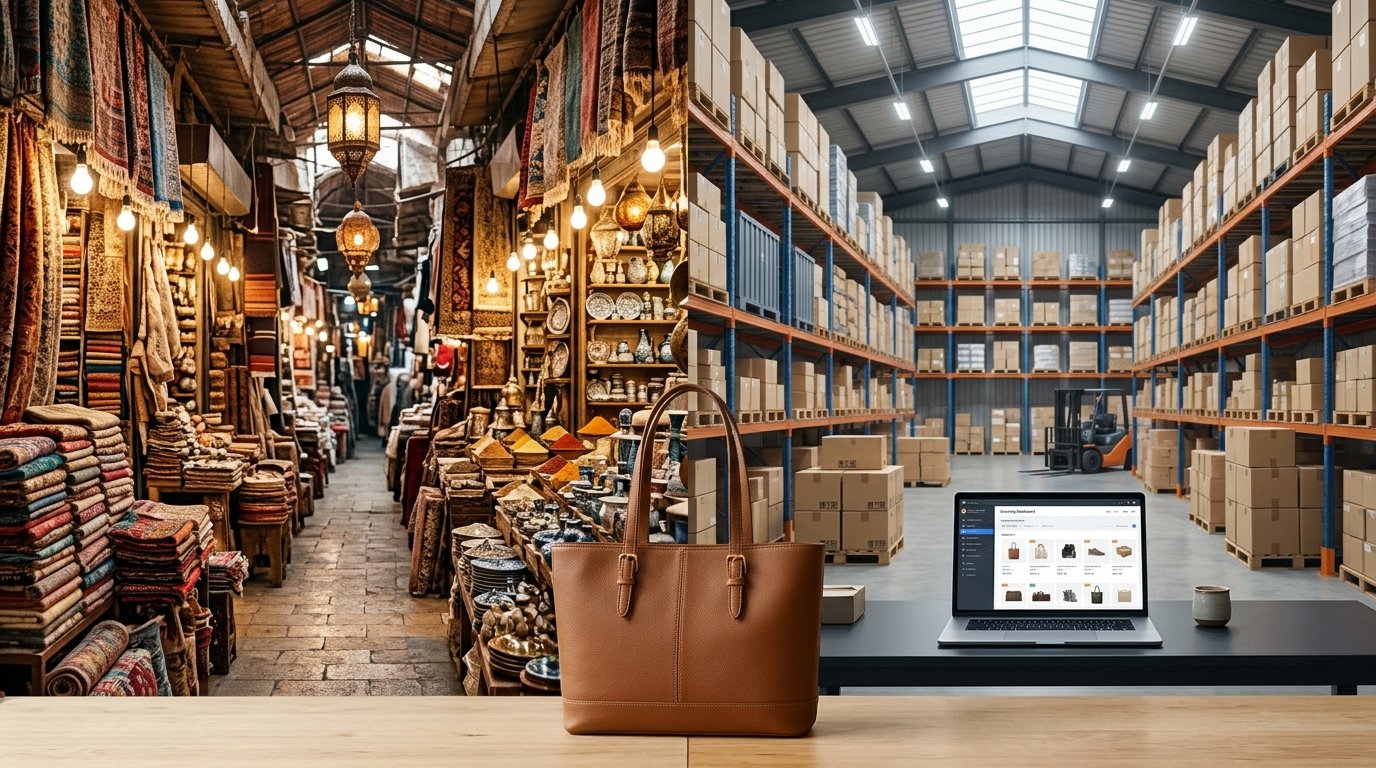
Every small retailer in Pakistan eventually asks the same question: should I buy from Alibaba or from a local wholesale market? The honest answer is "it depends" — but the decision is far more predictable than most people think once you break it down by cost, MOQ, quality, and risk. This guide gives you a clear framework for 2026.
The Two Sourcing Worlds, Side by Side
Alibaba is a global marketplace that connects you directly to manufacturers and trading companies, mostly in China, India, Vietnam, and Turkey. Local wholesale markets in Pakistan — Bolton Market in Karachi, Shah Alam Market in Lahore, Jodia Bazaar in Karachi, Raja Bazaar in Rawalpindi — are physical distribution hubs where you buy from importers and wholesalers who have already done the sourcing work for you.
Each model has a distinct cost structure. Neither is universally cheaper. The right choice depends on four variables: order size, product type, cash flow, and how much control you need over quality and branding.
Cost Comparison: The Real Numbers in 2026
Retailers often assume Alibaba is automatically cheaper. That's only true above a certain order size. Here's what the numbers actually look like for a typical small retailer ordering accessories, home goods, or fashion items:
- Alibaba (direct import) — landed cost is usually 30–45% below local wholesale prices, but only if you order enough to absorb freight and customs. Below roughly $1,500 per shipment, freight eats the savings.
- Local wholesale market — you pay a 20–40% importer margin, but you have zero freight, zero customs clearance, no currency exposure, and no MOQ beyond what the shopkeeper will sell you.
- The crossover point — most categories break even at roughly $1,200–$2,000 per order. Above that, direct import wins on cost. Below it, local markets win.
That crossover is why a small shop selling 20 units per SKU should not be importing from Alibaba directly. A distributor moving 200 units per SKU should absolutely be there.
MOQ: Where Alibaba Hurts Small Retailers Most
Every Alibaba supplier lists a minimum order quantity. For accessories it's often 50–200 pieces per style. For electronics it can be 500+. Local wholesale markets have no MOQ — you can buy 3 pieces of a design and 5 of another.
There are three ways to work around Alibaba MOQ in 2026:
- Order a mixed container — pick 8–10 styles from one supplier and hit the MOQ per style at a reduced total commitment.
- Use a sourcing agent in China — agents consolidate orders from multiple factories and ship them together, effectively splitting the MOQ across buyers.
- Buy from "ready stock" suppliers — some Alibaba suppliers hold stock and sell in small quantities at a premium of 10–20%. Good for testing a new product.
Quality Variance: The Hidden Cost
Local wholesale markets let you see and touch the product before you pay. That is a huge advantage. On Alibaba, you're relying on photos, video calls, and sample shipments. A sample tells you what the supplier can produce, not what they will produce for your bulk order.
The realistic quality-control path for Alibaba is:
- Order a pre-production sample (usually $20–$80 with shipping).
- Approve the sample in writing with a spec sheet.
- Book a third-party inspection before shipment — typically $250–$400 per order.
- Never pay the 70% balance until you've seen the inspection report.
If you skip those steps, expect 5–15% defective units on a first order. Local wholesale markets don't have this problem because you buy only what you can see.
Delivery Time: 3 Days vs 30 Days
This is often the deciding factor. Local wholesale markets offer same-week delivery — you can restock a fast-selling item on Friday and have it on the shelf by Monday. Alibaba timelines in 2026 break down roughly like this:
- Sample — 7–12 days including shipping.
- Production — 15–30 days depending on the product.
- Shipping to Pakistan — 5–8 days by air express, 25–40 days by sea.
- Customs clearance — 3–7 days.
- Total first shipment — 40–60 days realistically.
For seasonal products (Eid collections, winter wear, school supplies), that timeline means you must order 2–3 months ahead. If your business can't forecast that far, local wholesale is safer.
Cash Flow and Currency Risk
Local wholesale markets accept cash, bank transfer, and often allow 15–30 day credit for regular customers. Alibaba requires advance payment — usually 30% deposit, 70% before shipping — with no credit terms unless you use Alibaba's Trade Assurance financing or a trade-finance bank.
Currency risk also matters. If you're paying in USD while earning in PKR, a 5% rupee depreciation can wipe out your margin. Local wholesale prices are quoted in PKR and are usually stable week to week.
Customs and Compliance
Direct import means you're the importer of record. That brings responsibilities local wholesalers handle for you:
- Duty and sales tax at the port — typically 20–40% on the landed value depending on the HS code.
- Product labeling requirements per Pakistan's Ministry of Commerce rules.
- Compliance documentation for regulated categories (electronics, cosmetics, food items).
- Registration with the relevant trade body if you're importing commercially.
Most small retailers underestimate this. If you're not set up to clear a shipment yourself, budget for a customs broker — typically PKR 15,000–30,000 per shipment plus duties.
So Which Should You Choose?
Here's a simple decision framework:
- Choose local wholesale markets if your monthly purchase budget per SKU is under PKR 300,000, you need fast restocks, you sell seasonal items, or you can't absorb currency risk.
- Choose Alibaba if you're ordering above roughly PKR 500,000 per shipment, you need custom branding or packaging, you're building a private-label line, or you can plan 2–3 months ahead.
- Use both if you're growing. Import 30–40% of your volume on Alibaba for margin and differentiation, and cover the rest from local markets for speed and cash flow flexibility.
A Hybrid Playbook for 2026
The most profitable small retailers we work with at Leuzon do three things:
- Test locally — buy small quantities from local markets to validate demand before committing capital.
- Source the winners on Alibaba — once a design proves it sells, import it directly for 30–40% better margin.
- Keep a local fallback — always maintain a trusted local wholesaler for fast restocks when a product unexpectedly goes viral.
That approach limits risk, keeps cash flowing, and captures the margin advantage of direct import on the products that are actually selling. If you want help setting up that hybrid model, talk to our sourcing team.
Frequently Asked Questions
Is Alibaba cheaper than local wholesale markets?
Only above a certain order size. In 2026 the crossover point is roughly PKR 300,000–500,000 per shipment. Below that, freight and customs erase the savings.
Can I trust Alibaba suppliers in 2026?
You can, but only if you vet them. Verify the business license, get a factory video, request export documents, and always inspect before final payment. Never send 100% upfront.
What is the minimum order from Alibaba?
It varies by category — 50–200 pieces for accessories, 300–500 for electronics. Suppliers often negotiate down if you mix SKUs or accept stock colors.
How long does Alibaba shipping to Pakistan take?
Air express: 5–8 days after production. Sea freight: 25–40 days. Add production time (15–30 days) and customs clearance (3–7 days) for the full timeline.
Do I need a customs broker for Alibaba imports?
Yes, unless you already have experience clearing shipments. A broker typically charges PKR 15,000–30,000 per shipment plus duties. Budget for it from your first order.